By
Amanda McDowell
August 13, 2026
•
14
min read
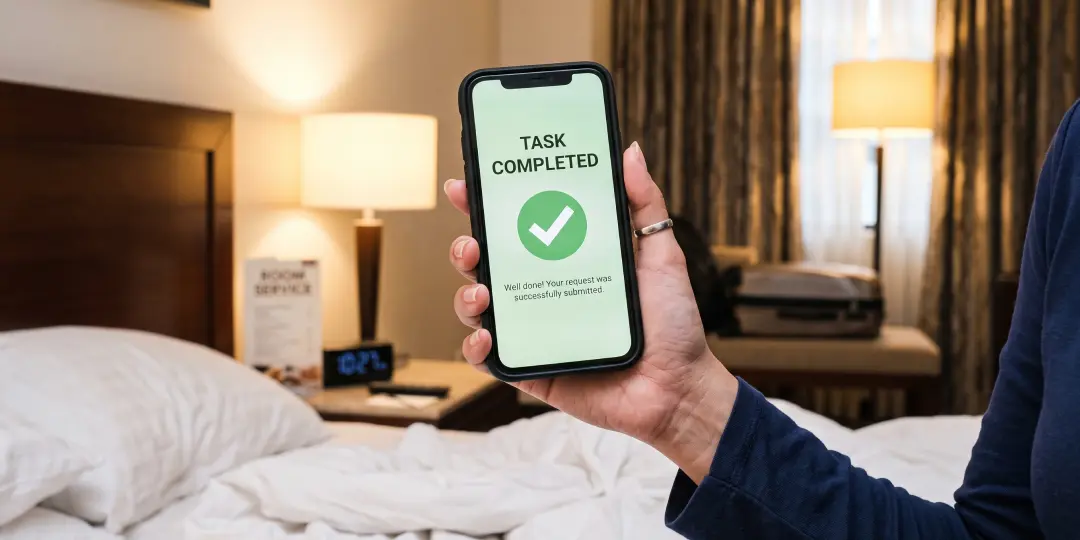
AI in the hospitality industry has moved beyond simple chatbots and content generation. Now, hoteliers are turning their focus toward Agentic AI for hospitality — the next major tech evolution that gets work done for you. Instead of answering questions or drafting text, AI agents complete entire tasks, from confirming a booking change to routing a maintenance request to the right person on your team.
This guide breaks down what the technology actually is, how it works, where it fits across your operation and how to prepare your hotel for adoption without putting the guest experience at risk.
Key highlights:
AI agents for hospitality are software programs that can understand a request, make a plan and carry it out across your hotel’s systems without a staff member driving every step. While a chatbot just answers a question and a writing assistant drafts an email, an agent works through each step until the job is done or a human needs to weigh in. Give it a goal, like “confirm this guest’s late checkout and update housekeeping,” and it gets to work.
In a hotel context, agents are built for hospitality rather than generic business software. They understand what a folio is. They know the difference between a booking modification and a cancellation. And they connect directly to your property management system, so their answers reflect what’s actually happening at your property rather than a generic script.
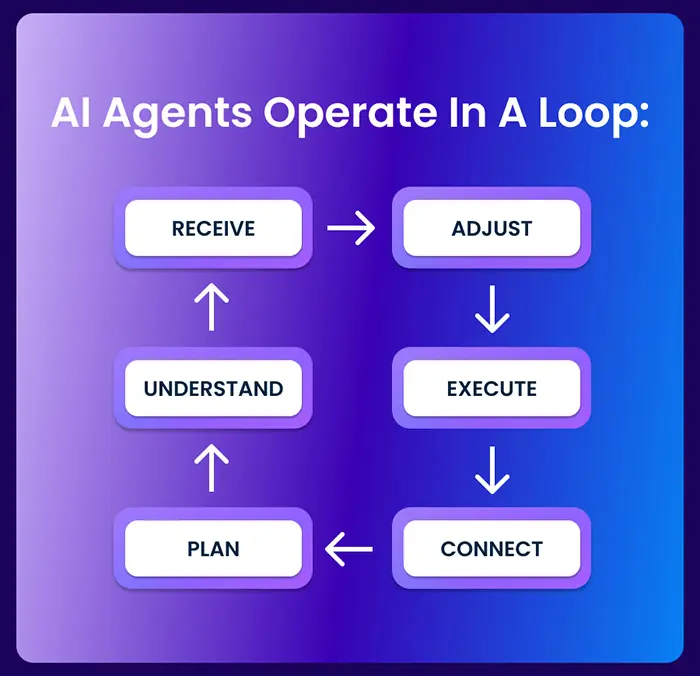
An AI agent for hotels works in a loop: take in a request, figure out what needs to happen, then go do it. While it’s simple to describe, it’s genuinely hard to build, which is why the technology has only recently become practical for hotels of every size.
Here’s what that loop looks like in practice:
These three terms are often used interchangeably, and the confusion costs hoteliers real money when they buy one expecting the other. AI agents for hospitality sit at the top of a capability ladder. Traditional automation is the bottom rung and generative AI is the middle. Agents combine the reliability of the first with the intelligence of the second, plus the ability to act.
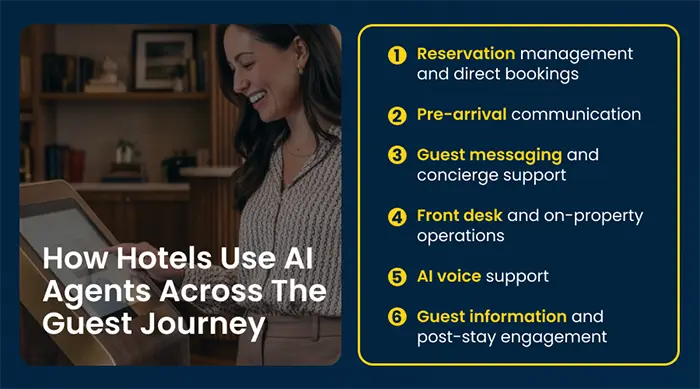
The best way to understand agentic AI for hospitality is to consider the entire stay. From the moment a traveler researches their options to the review they leave after checkout, there are dozens of small tasks that eat up your team’s time. Agents can take on most of them.
Travelers increasingly expect to book the way they message: instantly, conversationally and at midnight. The TravelBoom 2026 Leisure Travel Study found that 83% of travelers already use or want to use AI tools to plan their trips. If your website can’t answer “do you have a king room with a bathtub next weekend” in real time, that booking often drifts to an online travel agency (OTA) that can.
A hotel AI chatbot with agentic capabilities changes that outcome. It can:
The window between booking and check-in is where great stays are set up — agents use this time to enhance the guest experience without adding to anyone’s workload.
Strong pre-arrival guest communication handled by an agent confirms arrival times, collects preferences, answers the check-in questions before they hit your inbox and offers early check-in or room upgrades while the guest is still excited about the trip.
During the stay, agents become a tireless concierge. Connected to your guest messaging platform, they answer text or emailed questions about WiFi passwords, pool hours and dinner recommendations in seconds — and in the guest’s own language.
The quiet win here is triage. The agent handles routine tasks on its own and flags messages that actually need a staff member, like a complaint about a noisy neighbor, so your team spends time where it matters.
Your front desk handles an enormous amount of administrative work, which can distract staff from interacting with guests. Agents can reduce front desk friction by taking over the paperwork.
When managing hotel guest information updates, AI agents verify details, correct a misspelled name on a reservation, update contact information and sync those changes across systems so your staff isn’t retyping the same data three times. They can also collect registration details and payment information before the guest ever reaches the lobby.
The phone still matters in hotels. It’s also likely to go unanswered at 2 p.m. on a Saturday when the desk has a line five deep. An AI voice agent for hospitality businesses answers every call on the first ring, handles the common questions and books reservations over the phone.
AI voice technology built for hotels knows when to transfer. A caller asking about checkout time doesn’t need a human. A caller with a billing dispute always does. Good voice agents can tell the difference and route accordingly.
Checkout is actually the beginning of the next hotel guest journey. Agents follow up with thank-you messages, request reviews while the stay is fresh, respond to feedback and re-engage past guests with offers tailored to what they booked last time. That’s the kind of consistent follow-through most teams intend to do and never quite find time for.
Adoption of agentic AI is racing ahead of execution. A 2026 Wyndham Hotels & Resorts survey found that 98% of hotel owners have started using AI in some form, yet only 32% say it’s embedded across most of their operations. In other words, nearly everyone is experimenting and very few are realizing the technology’s full value. Agents are how hotels close that gap, because they turn scattered AI experiments into finished work.
Here’s what AI agents for hotels deliver when they’re set up well:
Hotels should prepare for agentic AI by starting with their most painful workflows, cleaning up their data and setting clear rules for what agents can and can’t do on their own. You don’t need a task force or a six-month rollout plan. You do need a deliberate approach, and here's how:
Start where the pain is loudest. Sit with your front desk for an afternoon and count how many times they answer the same five questions. Pull your call logs. Check how many bookings abandon at the payment step.
The best first workflows share three traits: they’re frequent, they’re repetitive and getting them wrong is low-risk. Answering “What time is breakfast?” fits; handling a chargeback dispute doesn’t, at least not yet.
An agent is only as smart as the data it can reach. If your PMS, messaging platform and payment tools don’t talk to each other, the agent ends up guessing, and guessing is where AI gets embarrassing.
Before rollout, audit your integrations and your knowledge base. Are your policies written down anywhere, and are they current? Is the parking fee on your website the same one your desk actually charges? Fix those gaps first. Agents amplify whatever information you feed them, accurate or not.
Decide upfront what the agent can do on its own, what needs approval and what always goes to staff. Write it down. Then build the escalation path so handoffs carry context, because nothing frustrates a guest like repeating their problem to a person after explaining it to a bot.
Sensible starting guardrails include:
Guests should feel your hotel’s personality in every interaction, automated or not. Train the agent on your voice, your standards and your service recovery playbook, and review its conversations regularly as you’d review a new hire’s.
Hoteliers themselves are clear-eyed about the limits here: agents should protect the human moments, not replace them, and pairing them with hotel reputation management tools makes sure the guest experience is actually improving as automation expands.
Pick one workflow. Run it for 30 days. Measure response times, resolution rates, staff hours saved and guest satisfaction before and after. Then expand to the next workflow with real evidence behind the decision.
This approach builds staff trust, too. Teams that watch an agent handle the boring stuff well become your biggest advocates for giving it more. Teams that get an ineffective tool dumped on them in week one never get on board.
Look for a platform that was built for hotels, connects deeply to your existing systems and keeps staff in control of the moments that matter. Plenty of vendors have bolted the word “agent” onto a basic chatbot this year, so it pays to evaluate carefully. Use this table as your checklist:
Canary was built for hotels from the start, which is exactly what you want in an AI partner. Canary AI Solutions power guest communication for thousands of properties worldwide, from independent boutiques to global brands, with agents trained on real hospitality conversations rather than generic text.
With Canary, your property gets:
Book a demo today and see how Canary’s agentic AI for hospitality can automate your hotel’s guest communications, improve operations and deliver more personalized service.
Quite a lot, and the list keeps growing. Today’s agents reliably handle guest FAQs, booking confirmations and modifications, pre-arrival outreach, upsell offers, review requests and routing of service tickets to the right department. On the revenue side, agents that engage website visitors in real time can help you increase direct bookings by answering the questions that would otherwise send travelers back to the OTAs.
Not if you deploy it well. Agents take the administrative load, which frees your team for the parts of front desk operations that actually require warmth and judgment: welcoming guests, solving problems and creating the moments people remember. Most hoteliers see it the same way, which is why the industry consensus is that arrival moments should stay human-led while agents work behind the scenes.
Three ways: speed (it answers in seconds), consistency (its answers always reflect your policies), and prioritization (it answers routine questions and escalates complicated conversations with full context attached).
Choose platforms with hospitality-grade security: encryption in transit and at rest, PCI compliance for payments and clear data retention policies. Tools like secure digital authorizations show what this looks like in practice, replacing faxed credit card forms with encrypted, compliant workflows. Also confirm your vendor doesn’t train public models on your guest data.
It depends on where you deploy first, but the returns typically show up in three places: staff hours saved on repetitive work, revenue gains from consistent upselling and recovered bookings and better review scores from faster responses. Measure a baseline before launch, then track resolution rates, upsell revenue and response times monthly so the numbers make the case for you.
Yes, and in some ways they benefit most. A 40-room independent doesn’t have a night team or an overflow call center, so an agent that answers every message and call is the closest thing to adding staff without adding payroll. Modern platforms are cloud-based with no hardware to install, and pricing scales with property size, so the technology that was once reserved for big brands is now within reach for nearly everyone.

Z našimi rešitvami boste dosegli večjo zadovoljstvo gostov z manj zaposlenimi in nižjimi stroški
.svg)



.png)


.jpg)

