By
Matej Cvikl
April 17, 2026
•
7
min read

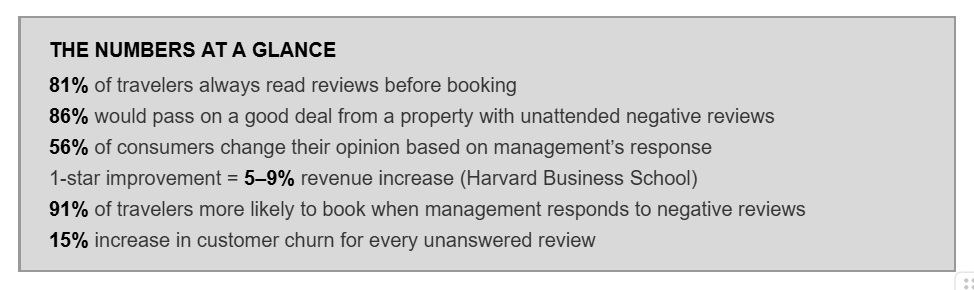
Over 81% of travelers read reviews before booking. A single unaddressed negative review can deter 30 out of 50 potential guests. Yet the global average hotel review response rate sits at just 40%. Here’s what that silence is actually costing you.
There is a particular kind of revenue loss that never appears on a hotel’s P&L statement. It doesn’t show up as a cancelled booking, a refund, or a discount applied at checkout. It’s the guest who never arrives, the traveler who opened your listing on Booking.com or Google, scrolled through three unanswered complaints about slow check-in, and quietly moved to the next property.
Industry research consistently shows that 81% of travelers read reviews before making a booking decision, with particular attention to how management responds to guest feedback. The data is equally clear about what happens when that feedback goes unanswered: a single unaddressed negative review can deter as many as 30 out of 50 potential customers. When 86% of travelers say they would pass on a good deal from a property with unattended negative reviews, silence becomes a measurable commercial liability.
Yet across the global hotel industry, the average review response rate hovers around just 40%. The gap between guest expectations and hotel execution is not a minor operational oversight. It is a structural revenue drain.
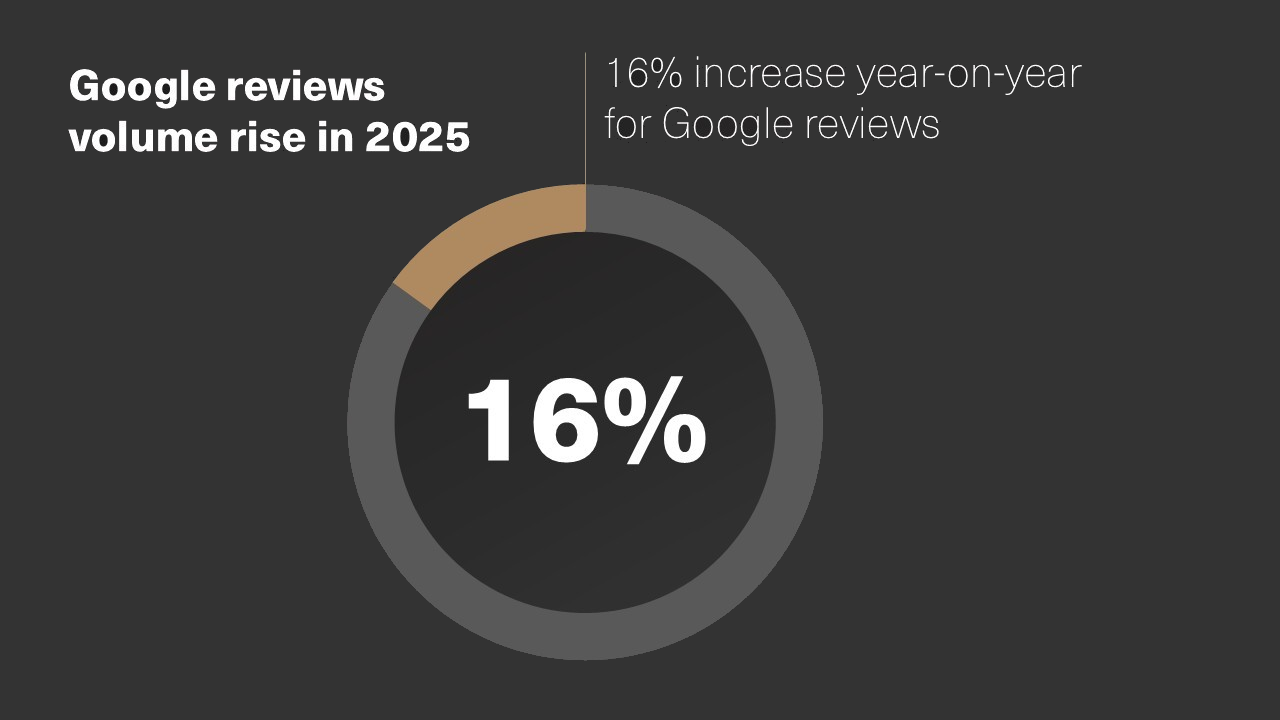
The review landscape has undergone a fundamental transformation. According to Shiji’s 2025 Guest Experience Benchmark, Google review volume grew almost 16% year over year, and for the first time since the pre-pandemic period, Google generated more guest mentions globally than TripAdvisor.
By the end of 2025, Google had climbed to 12.4 million mentions compared to TripAdvisor’s 10.3 million, a reversal that would have been unthinkable just two years earlier when TripAdvisor led with 11.6 million to Google’s 9.1 million.
This matters for two reasons. First, Google reviews are tightly integrated with search and maps, meaning they influence discoverability at the exact moment a traveler is making a booking decision. Second, Google’s algorithm factors in response rate and quality when ranking properties, hotels that actively engage with reviews gain measurable visibility advantages.
But perhaps the most consequential development isn’t happening on any single review platform. A 2025 survey found that 40% of global travelers have already used AI-powered tools, including ChatGPT, Gemini, and Perplexity, to plan their journeys, and 62% are open to doing so in the future. These AI travel planners don’t just display listings. They interpret, filter, and recommend based on the sentiment, specificity, and recency of your reviews.
As one industry analysis noted, AI systems treat active engagement with reviews as a positive signal. The sentiment in your review responses, the language you use, and the consistency of your replies all feed directly into whether an AI assistant recommends your property for a query like “What are the best family-friendly hotels in Dubrovnik under €200 per night?”
Referrals from ChatGPT to travel-related websites increased by 300% in just a few months during 2025. If your review profile is thin, stale, or dominated by unanswered complaints, you are not just losing human readers. You are becoming invisible to the fastest-growing discovery channel in travel.
The financial case for systematic reputation management is not speculative. A Harvard Business School study found that a one-star improvement on major review platforms correlates with a 5–9% increase in revenue.
A Cornell University study pushed the number even higher, showing that a one-point increase in review score, for example, from 3.5 to 4.5, can increase revenue by 11.2%.
The inverse is equally stark. Research indicates that customer churn increases by 15% for every piece of unanswered feedback. Meanwhile, 56% of consumers say they have changed their opinion of a business based on how management responded to reviews—not the review itself, but the response. The implication is powerful: your response strategy is as commercially important as the guest experience itself.
Consider what this means at scale. A 200-room hotel operating at 70% occupancy generates roughly 51,000 room nights per year. If even a small percentage of prospective guests are deterred by an unmanaged review profile—particularly during high-value booking windows—the revenue impact compounds rapidly across ADR and ancillary spend.
If the business case is so clear, why do 60% of hotel reviews go unanswered? The answer is rarely indifference. It is operational.
Guest Experience Managers and operations teams face a familiar set of challenges. Reviews arrive across multiple platforms, Google, Booking.com, TripAdvisor, Expedia, and increasingly niche channels like HolidayCheck, each with its own login, notification system, and response interface.
There is no unified dashboard by default. There is no centralized workflow. Many properties still rely on a single team member manually checking platforms, drafting responses in isolation, and hoping for consistency across hundreds of reviews per quarter.
Staffing constraints amplify the problem.
A front-office manager juggling check-ins, escalations, and shift scheduling rarely has protected time for review responses. When responses do happen, they tend to be reactive and formulaic, precisely the kind of generic replies that research shows do little to rebuild trust. The issue is not willingness. It is bandwidth and infrastructure.
The Shiji Q1 2025 Benchmark notes encouraging progress: global management response rates reached 69.2%, up 4.2 points year over year, with average response times dropping to just 3.1 days, down from 14 days in 2019. Properties investing in structured reputation management are clearly pulling ahead. But the gap between leaders and laggards is widening.
The most effective reputation strategy doesn’t begin after a guest posts a review. It begins while they are still on the property.
Digital guest engagement platforms, whether accessible via in-room IPTV systems, mobile apps, or messaging channels, enable hotels to collect real-time feedback during the stay. A mid-stay satisfaction check delivered through the guest’s own device or room screen creates a critical intervention window.
If a guest reports dissatisfaction with room temperature, housekeeping, or Wi-Fi connectivity at 2:00 PM on a Tuesday, the operations team has a chance to resolve it before checkout. That resolution converts what would have been a one-star review into a recovery moment, and potentially a positive review instead.
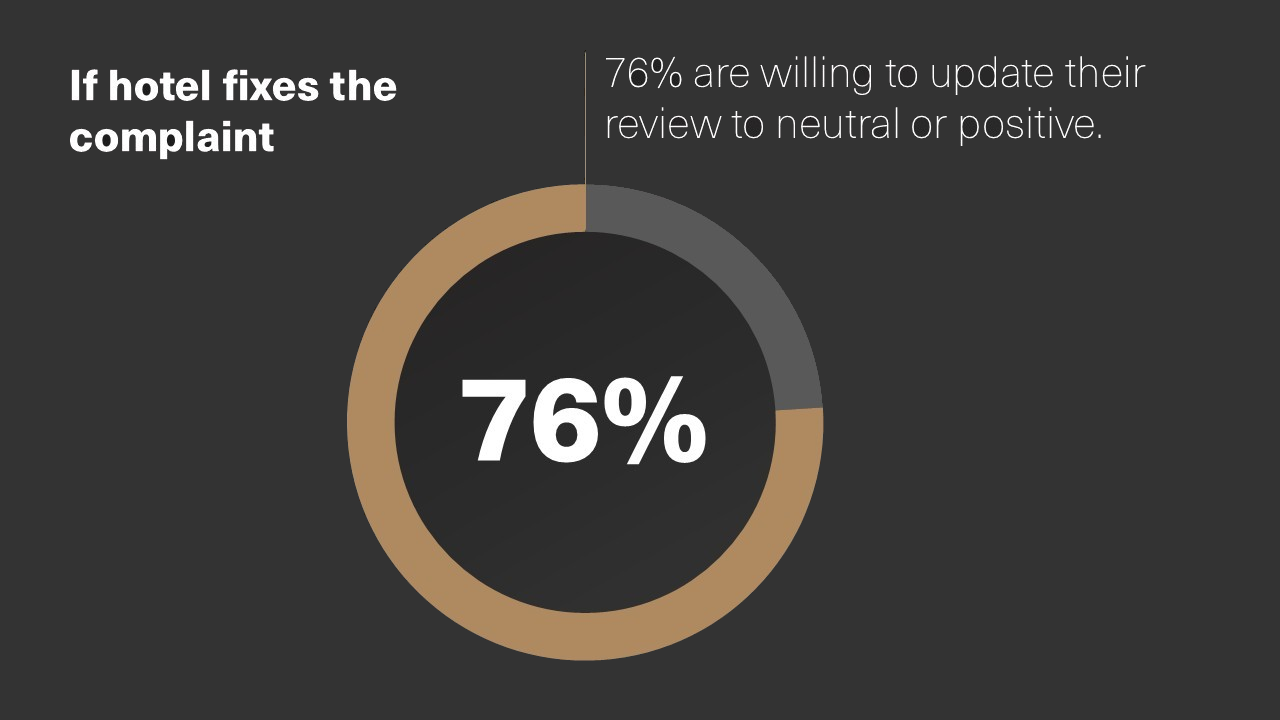
Research supports this: 76% of consumers say they would update a negative review to neutral or positive if the business acknowledged and fixed the complaint. The economics of pre-emptive feedback collection are compelling. A problem resolved during the stay costs a fraction of the revenue lost from a public negative review that deters dozens of future bookings.
The shift from reactive review management to systematic guest feedback integration follows a clear progression:
1. In-stay feedback capture: Digital touchpoints (room screens, mobile apps, messaging) prompt guests to share satisfaction scores and open comments during their stay, enabling real-time service recovery.
2. Automated post-stay survey distribution: Upon checkout, integrated systems automatically send personalized surveys, capturing detailed feedback while the experience is fresh and funneling satisfied guests toward public review platforms.
3. Centralized reputation dashboard: Reviews from Google, Booking.com, TripAdvisor, Expedia, and other channels flow into a single interface, enabling faster triage, assignment, and response.
4. AI-assisted response drafting: Natural language tools generate personalized response drafts that reference specific guest comments, maintaining authentic tone while dramatically reducing the time per response.
Properties that implement this full-cycle approach don’t just respond faster—they generate better reviews in the first place. And better reviews, as we’ve seen, flow directly to the top and bottom line.
In 2025, Booking.com updated its review scoring algorithm to weight recent reviews more heavily than historical ones. This means a hotel’s score now fluctuates more dynamically based on current guest sentiment.
A property that made significant improvements—renovated rooms, upgraded F&B, retrained front desk teams—will see those gains reflected faster in its public score. But the reverse is equally true: a dip in service quality or a cluster of unanswered negative reviews will drag scores down more quickly than before.
The strategic implication is clear. Proactive review generation is no longer optional, it is a competitive requirement. Hotels need a steady stream of fresh, positive reviews to maintain and improve their scores.
Digital guest engagement tools that prompt satisfied guests to leave reviews at the moment of peak satisfaction, immediately after a resolved service request, a memorable dining experience, or a seamless checkout, create exactly this kind of review velocity.
The Shiji 2025 Benchmark data reveals a clear performance divide. Properties with response rates above 80% and average response times under three days consistently outperform on guest satisfaction metrics.
The Middle East, which posted the highest regional GRI growth at +0.8 percentage points, also leads in response performance, with both three- and five-star hotels responding within three days and maintaining response rates exceeding 80%.
What distinguishes these leaders is not heroic individual effort. It is process maturity. They have moved from ad hoc review management, where one person checks TripAdvisor when they remember, to systematic, technology-enabled reputation workflows. Their approach typically shares several characteris:
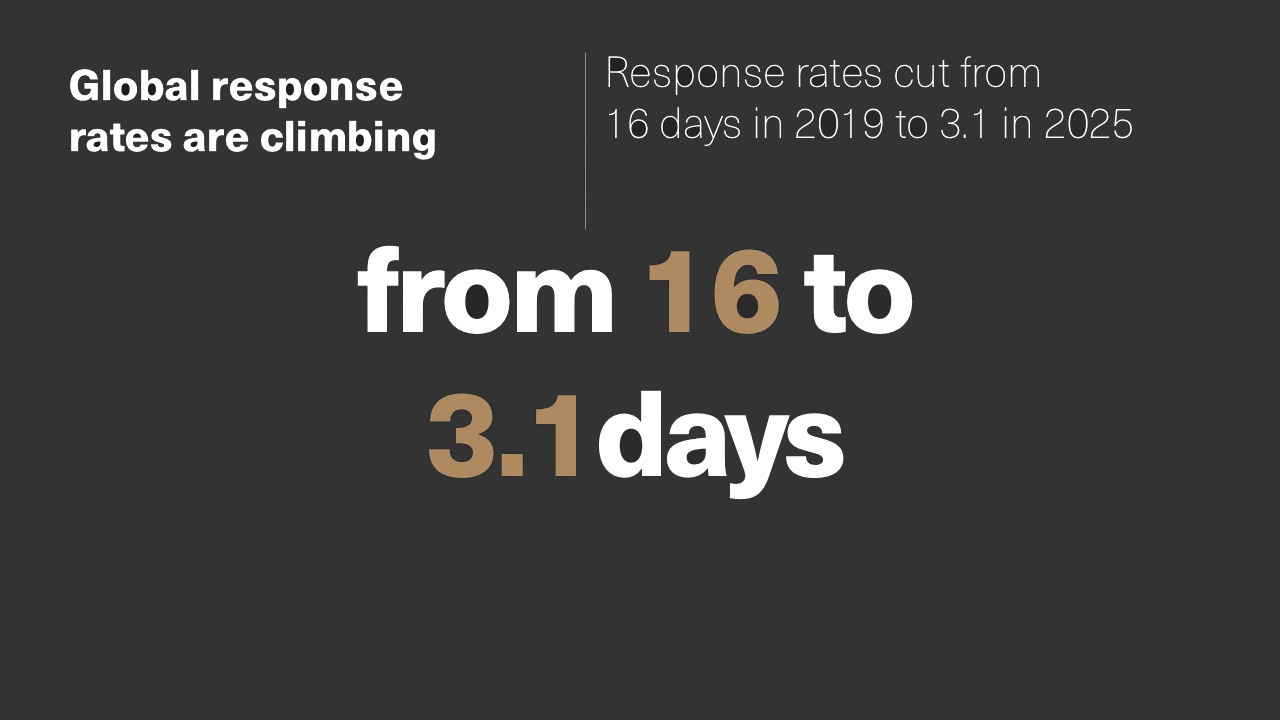
There is a narrow window in which reputation management remains a competitive differentiator rather than table stakes. The Shiji data shows that global response rates are climbing rapidly, from 65% to 69.2% in a single quarter, and response times have been cut from 14 days in 2019 to 3.1 days in 2025.
As AI-assisted response tools become ubiquitous, the baseline expectation will shift upward. Properties that are still operating at 40% response rates will find themselves not just underperforming, but conspicuously absent from the conversation.
The convergence of three forces Google’s dominance as a review platform, AI travel planners mining review content for recommendations, and Booking.com’s recency-weighted scoring, means that the penalty for reputation neglect is accelerating.
Every month without a systematic response strategy is a month of compound revenue loss from guests who never arrive, scores that drift downward, and AI algorithms that learn to recommend your competitors instead.
Reputation management is not a marketing function. It is a revenue function. The data is unambiguous: properties that systematically collect guest feedback, respond to reviews with speed and specificity, and integrate reputation workflows into their operational technology stack outperform on occupancy, ADR, and guest satisfaction simultaneously.
The question for hotel operators is no longer whether reputation management matters. It is whether your current infrastructure, your guest engagement tools, your feedback collection workflows, your response processes can keep pace with a landscape where every review is read by both human travelers and AI algorithms, and where silence is the most expensive response you can give.
A provider of guest experience technology for the hospitality and maritime industries offers IPTV systems, digital signage, and mobile guest engagement platforms.
The solutions help hotels and cruise operators capture real-time guest feedback, automate stay surveys, and build the digital infrastructure that supports strategic reputation management.
.jpg)
Z našimi rešitvami boste dosegli večjo zadovoljstvo gostov z manj zaposlenimi in nižjimi stroški
.svg)











.jpg.webp)